Customer Credit Risk Prediction and Identification
Competition: Third Sichuan University Financial Technology Modeling Competition Award: First Place **Awared by:**The Education Department of Sichuan Provincial
This project, presented for the Third Sichuan University Financial Technology Modeling Competition, focuses on customer credit risk prediction and identification. It emphasizes constructing a stable, high-performing binary classification model for credit risk management based on financial data.
Key Highlights
Data Analysis and Preparation
- Data Overview:
- Combined datasets include 24,983 samples and 205 features. After preprocessing, 124 features remain (33 textual and ~33% date-related features).
- Data Cleaning:
- Missing values:
- Median imputation for continuous variables.
- Mode imputation for discrete variables.
- Filling with
-99for features with >95% missing.
- Encoding methods:
- Count encoding for categories with <10 values.
- WOE binning for categories with >10 values.
- Time features are extracted based on hours/minutes or intervals from the current day.
- Missing values:
- Feature Selection and Engineering:
- Importance-ranked features selected via XGBoost.
- Featuretools used to generate new feature combinations.
Model Building
- Architecture:
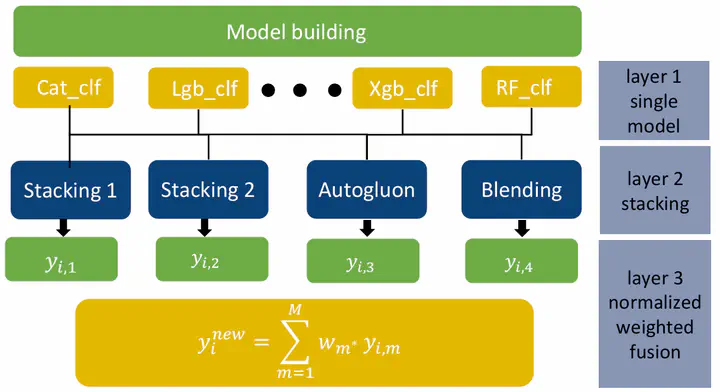
- Three-layered stacking framework:
- Layer 1: Base models include CatBoost, LightGBM, XGBoost, and Random Forest.
- Layer 2: Outputs from base models serve as inputs for four distinct sub-models.
- Layer 3: Final predictions are generated through normalized weighted voting.
- Three-layered stacking framework:
- Model Optimization:
- 5-fold cross-validation and grid search are applied to optimize hyperparameters for base models.
Evaluation
- Model performance is assessed using AUC (Area Under the Curve):
- Individual Models:
- CatBoost: 0.8486
- LightGBM: 0.8476
- XGBoost: 0.8464
- Random Forest: 0.8423
- Stacking and Voting:
- Stacking 1: 0.8523
- Stacking 2: 0.8530
- Voting: 0.8594 (Best Performance)
- Individual Models:
Credit Rating System
- Structure:
- Customers are classified into 9 levels based on predicted risk, with clear distribution and distinguishable credit tiers.
- 9.77% of users belong to the top levels (8 and above), reflecting the model’s discriminatory power.
- Implementation:
- Integrated with a web-based system using Docker and Vue.js for front-end services.
- Compared to FICO models, the system provides zones for:
- Quality customers.
- Value exploration.
- Overestimation.
- Risk elimination.
Conclusions and Suggestions
- The project demonstrates strong modeling capabilities through effective stacking and feature engineering.
- The authors suggest refining the model for real-world applications and exploring the scalability of the approach for diverse datasets.
This project presents a robust credit risk modeling framework with promising performance, practical implications, and room for further enhancement in financial technology applications.