A Synthetical Water Dispatching Model Give it or Give up
Competition: Mathematical Contest in Modelling Award: Finalist (Top: 2% among 27,205 Teams) Awarded by: the Consortium for Mathematics and Its Applications
Water Loss in Dams Due to Climate Change: A Mathematical Approach
Water loss in dams resulting from climate change has become a prominent problem in recent years, thus influencing humans’ life and production. To help address this issue, mathematical models are required to be established.
Problem 1
Problem 1 can be divided into three parts:
Service Area Coordination:
- Maps are rasterized, and service areas for two dams are classified using a Comparative Optimization Algorithm.
Comprehensive Dispatching Model for Water:
- Demand Side: An AIR Model is established to capture water demands, resulting in:
- 11858569 m³ to be drawn from the Glen Canyon Dam.
- 40978282 m³ to be drawn from the Hoover Dam.
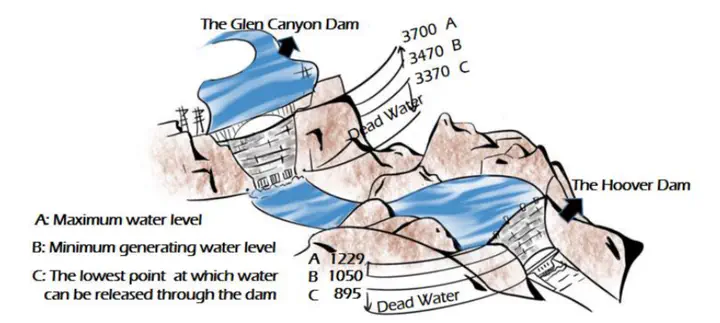
- Supply Side: Analysis of water levels and water volumes is conducted, with water-electricity generation fitted through Polynomial Interpolation, laying the foundation for subsequent analysis.
- Demand Side: An AIR Model is established to capture water demands, resulting in:
Dynamic Programming Model:
- Calculates the time until demands are unmet at fixed water levels:
- For the highest water level, the time is 495 days.
- Additional water as a function of time is derived (see Section 4.6).
- To consider Mexico’s residual claims, a Water-Supply Corridor Model is proposed, balancing respect for rights and interests (see Section 4.7).
- Calculates the time until demands are unmet at fixed water levels:
Problem 2
A Multi-Interest Tradeoff Model is developed using Goal Programming and Input-Output Theory:
- Economic Benefits as Criteria:
- Four “players” of competing interests are identified.
- Results include:
- 11848077 m³ drawn from the Glen Canyon Dam.
- 39125274 m³ drawn from the Hoover Dam.
- Reallocation results in increased water for industry and decreased water for agriculture (see Section 5.2, Table 5).
Problem 3
When supply cannot meet all water demand:
- Inspired by the NSGA-II Algorithm (a type of Genetic Algorithm), specific approaches are recommended:
- Reducing the scale of industries with low water-use efficiency and allocating more water to efficient industries.
- Promoting technological innovation in industries with low water-use efficiency to improve resource utilization.
Conclusion
To ensure robustness, sensitivity analysis is conducted, and a summary article containing findings and suggestions has been written for the Drought and Thirst Magazine.